
Challenges in supplier management are the operational drawbacks that end up being a bottleneck for procurement and quality teams from governing suppliers. Typically, it includes fragmented supplier data, time consuming onboarding, expired certificates, unmeasured OTIF, pending NCRs, underlying operational risk and one-sided communication. All of these emerge from managing suppliers through excel sheets, emails and ERP modules holding transactions but failing to enforce compliance or performance. For regulated industries like Food, Pharma and Manufacturing, it ends ups in a failed audit, production stoppage and reactive firefighting. These seven challenges have a one stop solution; centralized SRM removes all of them by pivoting scattered supplier records into one governed system of record.
What Are the Most Common Challenges in Managing Suppliers?
It always starts from a structural gap between buying goods and governing the suppliers who deliver them. Eventually, they get translated into missing certificates (ISO 9001, GMP, BRCGS), nuanced delivery performance (OTIF), high defect rates (PPM), and non-conformance reports (NCRs) hanging from months. Each gap is the root to a bigger challenge that raises supply chain risk and traces back to supplier information being scattered, stale or unenforced.
These are not purchasing loopholes. Purchasing, as always, has been transactional: a purchase order, detailed receipts and an invoice is all you need. These issues are operational: locking that a supplier is qualified, compliant and performing during and after every order. That, we identify as, the core of supplier relationship management, ensuring compliance, tracking performance and enforcing corrective actions. It is a systematic discipline of governing supplier interactions across the lifecycle.
Why do so many procurement teams still struggle with this? Mid-sized manufacturers often govern hundreds of suppliers with tools that were built for something else.
In this blog we explain why those tools fail.
Why Excel, Email and Most ERP Modules Fail at Supplier Governance
Manual supplier management with Excel, Email or shared drives is like working in a data center, it stores the information but does not govern or enforce anything and hence it fails. A spreadsheet cannot warn anyone when a GMP certificate is expiring. An inbox cannot force a supplier to submit root cause analysis. A shared folder cannot analyze which version of a quality agreement is updated. The outcome is data silos, tribal knowledge held by a few buyers and team that firefights instead of supplier development.
Yes, we expected the ERP modules to close this gap, but most ERP modules ended up focusing on purchase orders, invoices and thee -way matching. Operational SRM has a laser focus on governance: ensuring the goods you buy come from qualified, compliant and performing suppliers. An ERP may know when a delivery is late but does not open a corrective action or update a supplier scorecard or trigger a requalification. The difference between recording a transaction and governing a relationship is behind every challenge below.
7 Supplier Management Challenges in Regulated Supply Chains
To dig deep into where operational exposure comes from, procurement and quality teams must evaluate the seven supplier management challenges listed below.
1. Fragmented Supplier Data Across Spreadsheets, Inboxes and ERP Systems
2. Time Consuming, Manual Supplier Onboarding and Pre-Qualification
3. Expired Certificates and Supplier Compliance Gaps (ISO, GMP, GFSI)
4. No Objective Supplier Performance Data (OTIF, PPM, Delivery Reliability)
5. Unresolved Quality Defects: NCRs and CAPAs Without Ownership
6. Limited Visibility Into Operational Supplier Risk
7. One-Way Supplier Communication Instead of Collaboration
1. Fragmented Supplier Data Across Spreadsheets, Inboxes and ERP Systems
We start from the root cause behind all other challenges: Fragmented supplier data. If we track this workflow down, contact details live in the ERP vendor master, certificates sit in a shared drive, audit reports are in someone's inbox and performance noted are in a buyer's personal notetaker or notebook (worse case). A single source of truth? No existing? So, every question about a supplier (Is their ISO 9001 certificate valid? What did we agree after the last audit) turns into a search.
Fragmentation is also the source for dark data. When a category manager signs out, their supplier knowledge also leaves with them because it was never retained in a shared system. Supplier master data management fixes this by giving every supplier one profile that holds master data, documents, contacts, contracts, performance history and open issues together. We have covered structural risks of tracking suppliers in Excel are covered in detail in SRM vs. spreadsheets.
How to fix it: A centralized supplier profile in LeanLinking that syncs with ERP systems such as SAP and Oracle, so the ERP keeps the transactions and the SRM keeps the relationship.
2. Time Consuming, Manual Supplier Onboarding and Pre-Qualification
Manual supplier onboarding is time consuming because every step depends on an email being addressed. Procurement shares a questionnaire as a word file, the supplier returns it half-complete, quality asks for a missing certificate, and weeks later the supplier is still not approved. Meanwhile production needs the material, so the supplier gets used before qualification is finished: the exact compliance gap that auditors look for.
If we need to reduce the supplier onboarding time without compromising the standard, onboarding has to run as a workflow and not just a mailbox. The supplier fills out a structured self-registration, uploads the required documents, and addresses a pre-qualification questionnaire inside one single portal. Nothing moves to 'approved' until all mandatory fields and certificates are in place.
How to fix it: Automated onboarding with supplier self-service, structured questionnaires and document requests that act as the gatekeeper to your approved supplier list.
3. Expired Certificates and Supplier Compliance Gaps (ISO, GMP, GFSI)
Supplier compliance is silent collapse. A supplier's ISO 9001, GMP pr BRCGS certificate expires, nobody notices and the gap only appears during a regulatory audit. Every time an expiry date is tracked in a spreadsheet it needs someone to open it, filter it and chase each supplier every week, for hundreds of documents.
Supply chain regulatory compliance in Food, Pharma and Manufacturing needs a continuous proof, not a yearly clean-up. Audit readiness means any auditor, on any day has visibility into a complete and current audit trail for every active supplier.
How to fix it: Certificate management with automated expiry reminders sent directly to the supplier, renewal uploads through the supplier portal, and a full audit trail of every version.
4. No Objective Supplier Performance Data (OTIF, PPM, Delivery Reliability)
Gut feeling can not be framework for supplier performance management and it tends to be, if not supported by objective data. Buyers always have memory of the last bad deliver and not a 12-month trend. Quarterly business reviews are settled in debates instead of fact-based negotiations. The only reason to be that numbers were not agreed during an On-Time In-Full (OTIF), defect rate (PPM) or responsiveness.
Supplier performance tracking and monitoring needs hard metrics from ERP data, along with soft metrics from internal stakeholder surveys, weighted and shared with the supplier. Because manual data extraction creates fragmented versions of the truth, quality and procurement teams rely on automated supplier performance scorecards to remove subjective bias and measure every supplier on the same criteria.
How to fix it: Automated scorecards in LeanLinking that combine OTIF, PPM and stakeholder feedback into one score the supplier sees in their own portal.
5. Unresolved Quality Defects: NCRs and CAPAs Without Ownership
A useful non-conformance report (NCR) leads to a fix. Emails and Excel sheets defies the purpose of an NCR, ownership is lost and the supplier never confirms the root cause. Corrective and Preventive Action (CAPA) runs without deadlines and the same defect returns in three months. Supplier management becomes a loop of complaints instead of improvement.
Only a structed workflow for NCR can bring a positive impact in supplier quality performance. A standard workflow includes severity classification, a root cause analysis and a CAPA with an owner and due date, and verified effectiveness. The supplier is required to work on the NCR in the same system where it was raised.
How to fix it: The LeanLinking NCR module, where suppliers submit root cause analysis and corrective actions directly, and every open issue feeds into their scorecard.
6. Limited Visibility Into Operational Supplier Risk
Most of the times, supplier risk is not geopolitical, it is operational. A supplier whose ITIF is slipping, certificates are expiring next month, or has three open NCRs on a critical component. These signals already exist, but they are scattered across systems and nobody sees the pattern in them until the production stops.
Supply chain visibility at the operational level means visibility into compliance status, performance trend and open quality issues together, per supplier and per category. Teams then act on early warnings instead of reacting to disruptions.
How to fix it: A 360° supplier view and dashboards that combine compliance, performance and NCR data, so supplier risk shows up early.
7. One-Way Supplier Communication Instead of Collaboration
Suppliers are working blindly only if communication is running through emails. They do not see how they are scored, which documents are missing, or which issues are open. Every request becomes a new thread, and the relationship stays transactional instead of collaborative.
Supplier collaboration needs a shared space where both sides see the same facts. When suppliers see their own scorecards, upload their own documents and respond to NCRs directly, they take ownership of improvement, and procurement stops being a reminder service.
How to fix it: A supplier portal in LeanLinking that gives suppliers self-service access to their documents, scorecards and open actions, with communication history logged on the supplier profile.
How Do Supplier Management Challenges Differ in Food, Pharma and Manufacturing?
The seven challenges are the same across regulated industries, but the standard each one is judged against changes by sector.
- Food & Beverage (GFSI schemes (BRCGS, FSSC 22000, IFS), HACCP): Supplier management challenges in the food industry centre on certificate validity and traceability. An expired BRCGS certificate or a missing allergen declaration puts product safety and retailer listings at risk.
- Pharma & Life Sciences (GMP, 21 CFR Part 11, GDP): Every supplier of an API, excipient or packaging component must stay qualified, and every record must have a validated audit trail. Uncontrolled supplier documents are a direct inspection finding.
- Manufacturing & Automotive (ISO 9001, IATF 16949, ISO 14001): The pressure is performance: OTIF and PPM targets, PPAP documentation and fast CAPA closure. One late or defective component stops a production line.
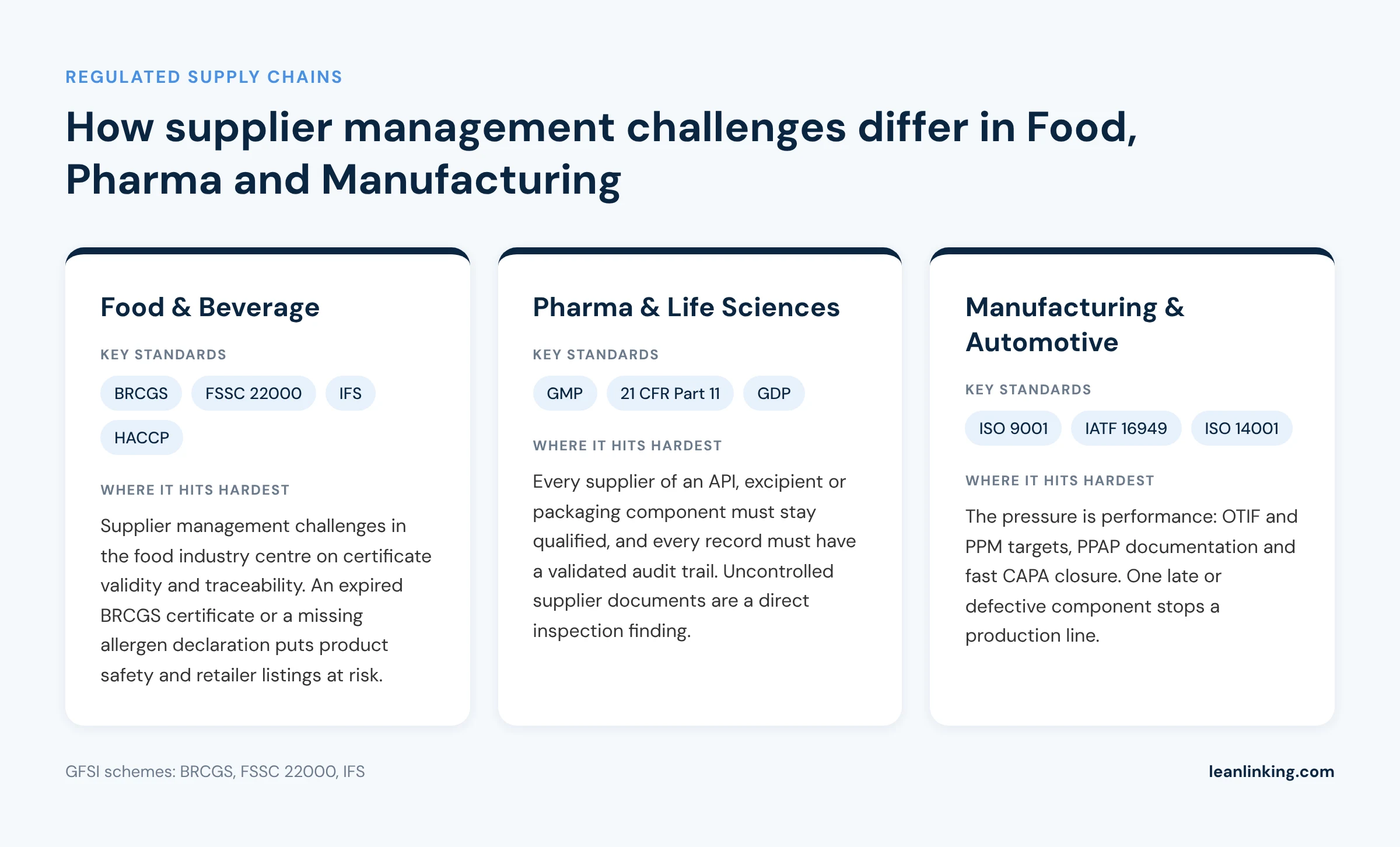
In each of these industries, supplier governance acts as a compliance shield. It protects audit readiness, product safety and production continuity at the same time.
Procurement Challenges and Solutions: Supplier-Side FAQs
Can an ERP System Solve Supplier Management Challenges?
No, an ERP system does not solve supplier management challenges on its own. An ERP records purchase orders, goods receipts and invoices, but it does not chase expiring certificates, run supplier self-service onboarding, or force a supplier to complete a corrective action. Those are governance workflows. They need dedicated SRM software that integrates with the ERP instead of replacing it.
How Do You Solve Supplier Management Challenges?
You solve supplier management challenges by replacing scattered tools with one governed process:
- Centralize every supplier record, document and contact in one system of record.
- Automate onboarding questionnaires, document requests and certificate expiry alerts.
- Measure every supplier on objective metrics such as OTIF and PPM, shared through scorecards.
- Manage NCRs and CAPAs inside a shared supplier portal with owners and deadlines.
- Review operational supplier risk continuously, not once a year.
What Are the Biggest Challenges in the Procurement Process?
On the supplier side, the biggest procurement challenges are the seven covered above: fragmented supplier data, slow onboarding, compliance gaps from expired certificates, missing performance data, unresolved quality defects, limited risk visibility and one-way supplier communication. Price and spend challenges matter too, but they are symptoms. A supplier who delivers late, fails audits or ships defects costs more than its unit price shows.
How SRM Software Solves Supplier Management Challenges
Supplier relationship management software solves these challenges by moving supplier governance out of inboxes and spreadsheets into one operational system. Each challenge maps to one capability:
- Fragmented supplier data: Centralized supplier profiles synced with SAP, Oracle and other ERPs
- Slow onboarding: Supplier self-registration, questionnaires and automated document requests
- Expired certificates: Certificate management with automatic expiry reminders and full audit trail
- No performance data: Automated scorecards combining OTIF, PPM and stakeholder surveys
- Unresolved defects: NCR module with root cause analysis and CAPA tracking
- Hidden operational risk: 360° supplier view and risk dashboards
- One-way communication: Supplier portal with shared scorecards, documents and actions

The result is a shift from reactive firefighting to proactive governance. Audits become a demonstration of control, supplier reviews run on facts, and quality issues close instead of repeating.
To remove all seven challenges from one system of record, regulated manufacturers deploy dedicated supplier management software that acts as their Supplier Cockpit, enforcing compliance, measuring performance and driving corrective action across every supplier.
Book a demo to see how LeanLinking centralizes your supplier data, automates certificate tracking and closes NCRs faster.